I work with students who have suffered all types of trauma. Now, the disgusting policy of separating immigrant children and their parents has brought the impact of trauma to the forefront, a place I truly believe it should always be. Of course, I discuss the concept of trauma frequently at work. This past week, was the first time, I related my autoimmune issues to the idea. I asked a colleague if they thought my diagnosis constitutes as trauma, to which she quickly responded, “Yes, it has changed the way you live, the way you think and it has impacted your family in the same ways.” It got me thinking.
The word trauma is derived from the Greek word for “wound.” My dictionary defines trauma as a deeply distressing or disturbing experience. When presented like this, day to day life events could be considered traumatic.
The DSM defines trauma as, “A direct personal experience of an event that involves actual or threatened death or serious injury, or other threat to one’s physical integrity; or witnessing an event that involves death, injury, or a threat to the physical integrity of another person; or learning about an unexpected or violent death, serious harm, or threat of death or injury experienced by a family member or other close associate (APA, 2000, p. 463). The second prerequisite (A2) required that the survivor must have experienced “intense fear, helplessness, or horror” (p. 467) following the event. Clinicians and researchers have criticized both requirements (Breslau & Kessler, 2001; Friedman, Resick, Bryant, & Brewin, 2011).”
I have been “not feeling well” since 2015. I was officially diagnosed with Rheumatoid Arthritis eight months ago. During that brief time, I was prescribed plaquenil, sulfasalazine, three different dosages of methotrexate, numerous cycles of prednisone and now methotrexate injections. My kids have watched me become less of myself. I have mourned what I thought my life was supposed to be like. My husband is angry, and as my protector wants to fix me. (I am well aware that as a woman, I do not require protecting nor fixing, but you can imagine the stress, heartache and sadness that he is dealing with as well.) This chronic illness has had a direct personal impact to my physical and mental integrity. My loved ones have borne witness to it.
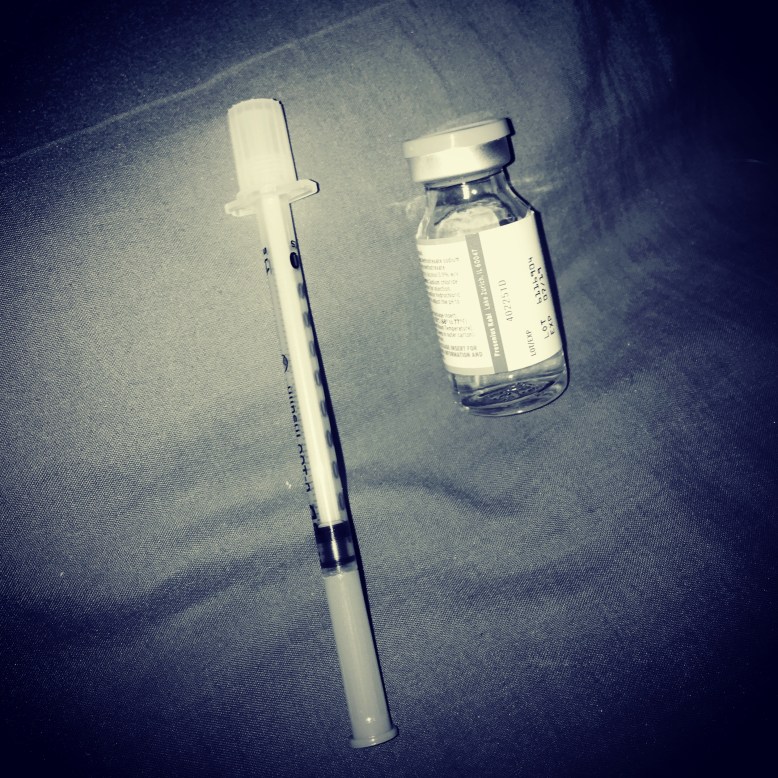
There are days that I feel great! I have energy and little to no pain. There are other days that are just plain hard. This past Friday, was my first round of methotrexate injections. My husband called our friend, a nurse, so he could walk him through filling the syringe. It was a disaster. He was nervous. I was scared and to be honest, pissed off. There it was, this syringe filled with some odd yellowish colored liquid. It just looked like poison to me. It felt unnatural to be injecting something so foreign into my body. We took a deep breath and did it. Then I cried myself to sleep as he held my hand under the covers. It was just one more blow to my self ideal.
Skip ahead to today, Sunday. (I felt like a truck hit me on Saturday, but I sort of expected it.) I woke up a little more refreshed than usual. I found my walk to the bathroom not as painful. By noon, I had folded 2 loads of laundry and returned to the bathroom to actually clean it. I was able to get down on my hands and knees and scrub places that haven’t been properly cleaned in months! When I am done writing this, I plan on doing the same in the downstairs bathroom as well. I know I may be a little sore tonight or tomorrow, and that will be okay. Who knows how long this dose or medication will work. For now, I am just grateful for it
So let’s revisit whether or not a chronic illness can be considered trauma. I wholeheartedly believe the answer is yes. I understand that my life and body will never be the same. I know that I need to alter my way of performing some tasks, as well as change the way I think about things. The latter is categorically more difficult. It is not easy to modify and reshape your thoughts. Wish me luck!
 Overhauling Mama
Love you Colleen, remember I am always here
Thanks Auntie. Love you too.